The roof that outlasts everything else
Metal roofs last 40 to 70 years with almost no maintenance. In LA’s climate, that means you install it once and probably never think about it again. No cracking from UV, no shingle blow-offs from Santa Ana winds, no moss or algae growth.
We install and repair metal roofing for residential and commercial properties across Los Angeles. Standing seam, corrugated, metal shingles, and stone-coated panels. From Mid-Wilshire bungalows to canyon homes in the Palisades, the right metal system depends on your architecture, your fire exposure, and how close you are to the coast.
Metal roofing types
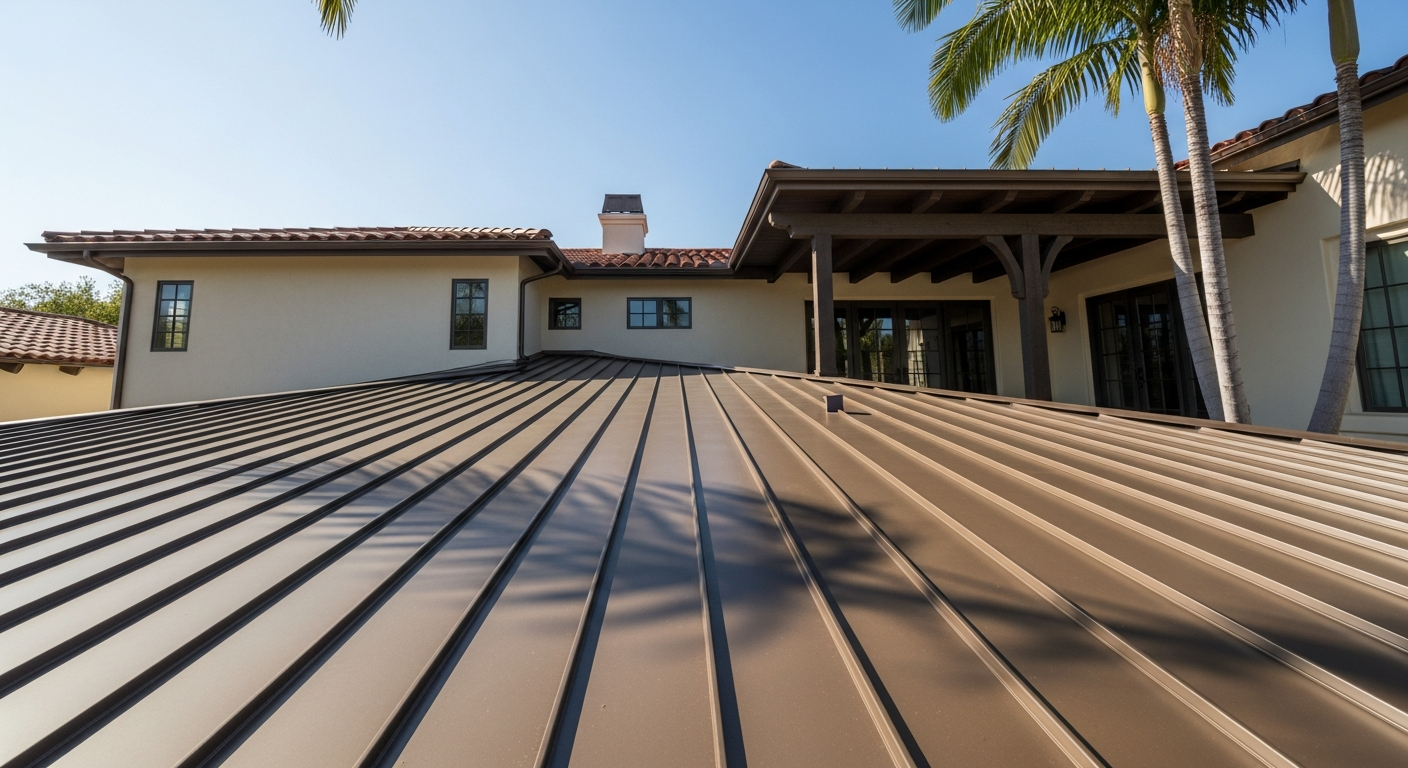
Standing seam is the premium option: raised seams with concealed fasteners, so no exposed screws and no potential leak points. The clean, modern look works on everything from mid-century homes to contemporary new builds.
Corrugated metal with exposed fastener panels is more affordable and the right choice for garages, sheds, and certain architectural styles. R-panel and PBR-panel profiles are popular for commercial and industrial applications and for homeowners who want a metal roof on a tight budget.
Metal shingles are individual pieces designed to look like traditional shingles, tile, or slate. You get the longevity of metal with a more conventional appearance if standing seam feels too modern for your home. Stone-coated steel is the most common product in this category and the easiest to get past a strict HOA.
Still deciding between panel types? Our guide comparing standing seam, corrugated, and ribbed metal roofing for LA homes breaks down cost, lifespan, and fire rating side by side.
Standing Seam Metal Roofing in Los Angeles
Standing seam is the most-requested metal system in LA, and for good reason. The panels run vertically from eave to ridge, locked together along raised seams that hide the fasteners from weather. No exposed screws means no rubber gaskets to dry out, no screw holes working loose under thermal cycling, and a much cleaner roof line.
A few things to know when you are comparing standing seam quotes:
- 24-gauge vs 26-gauge steel. 24-gauge is roughly 25 percent thicker and noticeably more dent-resistant. It is the standard for residential standing seam in LA and the gauge we recommend for any home where falling branches or hail are a concern. 26-gauge costs less and works fine on lower-profile installations and outbuildings.
- PVDF (Kynar 500) vs SMP finishes. Kynar 500 (also sold as Hylar 5000) is the premium PVDF paint system. It resists chalking, fading, and UV breakdown for 30 to 40 years and is what you want under LA’s near year-round sun. SMP (silicone-modified polyester) is the budget alternative. It fades faster, usually within 10 to 15 years in direct LA sun, and the warranty is shorter.
- Snap-lock vs mechanical seam. Snap-lock panels press together with hand pressure and are the standard for most residential roofs. Mechanical seam systems are crimped closed with a powered seaming tool and are tighter against wind-driven rain. Mechanical seam is the right call on very low-slope sections and in high-wind canyon locations.
- Panel widths. 12-inch, 16-inch, and 18-inch panels are the common residential widths. Narrower panels look more refined on smaller homes and historic remodels. Wider panels go up faster and cost slightly less per square foot.
- Concealed fastener advantage. Exposed-fastener metal panels rely on neoprene washers that bake out under LA’s UV exposure within 10 to 15 years. Standing seam moves that failure point inside the seam, where it stays cooler and lasts the life of the panel.
A standing seam metal roof on a typical LA home runs $9 to $15 per square foot installed. The spread depends on gauge, finish, panel width, trim complexity, and the number of penetrations.
Metal Roof Cost in Los Angeles
Metal roofing covers a wide price range depending on the material and the profile. Here is what each system costs installed in the LA market:
- Corrugated steel: $7 to $10 per square foot
- R-panel / exposed-fastener systems: $7 to $10 per square foot
- Standing seam steel (26-gauge SMP): $9 to $12 per square foot
- Standing seam steel (24-gauge PVDF): $11 to $15 per square foot
- Metal shingles (stone-coated steel): $10 to $14 per square foot
- Aluminum standing seam: $12 to $18 per square foot
- Zinc: $18 to $30 per square foot
- Copper: $20 to $35 per square foot
For a typical 1,500 to 2,500 square foot LA home, that puts a full installed metal roof in the $12,000 to $35,000 range. Tear-off of the existing roof adds $1,500 to $4,000 depending on what is coming off (asphalt strips quickly, tile takes longer). Decking repair runs $75 to $120 per sheet of plywood. Permits in the City of LA run $500 to $1,200.
For a deeper breakdown by neighborhood and roof size, see our metal roof cost guide for Los Angeles.
Metal Roofing by LA Neighborhood Use Case
The right metal system depends on where your home sits. Here is how we approach the main areas of LA.
Pacific Palisades, Malibu, and Topanga
These are Very High Fire Hazard Severity Zones under California Building Code Chapter 7A. Class A roofing is required, and metal’s inherent Class A rating makes it one of the strongest choices for ember resistance. Standing seam in particular leaves no gaps where embers can lodge or work their way under the panel. For these neighborhoods we specify aluminum or Galvalume substrate and stainless steel fasteners — salt air at this distance from the ocean will corrode standard galvanized fasteners within 12 to 15 years. See our notes on fire-resistant roofing materials for California for the full code picture.
Hollywood Hills and Beverly Hills
Architecture in these neighborhoods leans modern, contemporary, and updated mid-century. Standing seam’s clean vertical lines work with steel and glass renovations, post-and-beam homes, and the contemporary new builds going up across Trousdale and the upper canyons. Narrower 12-inch panel widths in a matte PVDF finish are the look most architects in this area specify. Concealed fasteners and minimal trim keep the visual quiet.
San Fernando Valley
The Valley is where metal pays back fastest on energy. Roof surface temperatures regularly hit 150 to 170 degrees on August afternoons, and a cool-pigment metal panel can drop that to 100 to 110 degrees. Light-colored or cool-rated metal panels with a CRRC-listed finish qualify for LADWP’s residential cool roof rebate (covered in the next section). Standing seam in a light gray or off-white finish is the practical pick across Encino, Tarzana, Sherman Oaks, and Northridge.
Mid-Century Homes (Brentwood, Cheviot Hills, Studio City)
Mid-century post-and-beam houses often have low-slope roofs that fall below the pitch threshold for traditional shingle or tile. Mechanical-seam standing seam panels work down to 1:12 pitch and are the right answer for these homes. Narrow panel widths and a clean fascia detail preserve the original horizontal lines without making the roof look heavy.
Coastal Areas (South Bay, El Segundo, Manhattan Beach)
Salt-laden marine air is the limiting factor here. Aluminum standing seam is the default — it does not rust, period. Galvalume-coated steel (a zinc-aluminum alloy substrate) is a less expensive alternative that holds up reasonably well within a mile of the coast. Plain galvanized steel does not belong on a coastal roof. All fasteners should be stainless steel, and any exposed flashing should match the panel substrate to avoid galvanic corrosion at the joint. See our South Bay roofing page for more on coastal material choices across Manhattan Beach, Hermosa, Redondo, El Segundo, and the Palos Verdes Peninsula.
Cool Roof Rebates for Metal Roofing in LA
California’s Title 24 energy code applies to most reroofing projects in LA. For steep-slope roofs (3:12 pitch or greater), the code requires a minimum aged solar reflectance of 0.20 and thermal emittance of 0.75. Most light-colored and cool-pigment metal panels with a PVDF finish exceed both thresholds out of the box, so a properly specified metal roof generally clears Title 24 without any added effort.
LADWP has historically run a residential cool roof rebate that applies to qualifying metal panels. Rebate amounts have run in the $0.20 to $0.30 per square foot range, which works out to roughly $400 to $600 back on a typical 2,000 square foot home. To qualify, the product needs to be listed by the Cool Roof Rating Council (CRRC) and meet the program’s reflectance threshold for steep-slope or low-slope applications.
Program details and budget availability change year to year, so we confirm current LADWP terms before pricing your project. SoCalGas and SCE have offered related efficiency incentives in some years as well. For more context on how cool roofs perform in LA, see our cool roofs in Los Angeles post.
Metal Roofing Lifespan and Warranty
Metal is one of the longest-lived roofing systems on the market.
- Standing seam steel: 40 to 60 years of service life
- Aluminum standing seam: 50 to 70 years (no rust, ideal for coastal exposure)
- Stone-coated metal shingles: 30 to 50 years
- Copper and zinc: 70+ years, often 100+ in dry climates like inland LA
- Corrugated and R-panel: 25 to 40 years depending on gauge and finish
Warranties on metal roofing come in three layers. The panel substrate (the steel or aluminum itself) typically carries a 25 to 50 year warranty against rust-through and structural failure. The finish — PVDF, SMP, or cool-pigment coating — carries a separate 30 to 50 year warranty against chalking, fading beyond a measurable threshold, and adhesion loss. PVDF (Kynar 500) finishes are at the top end of that range. Workmanship is the third layer and is covered by our labor warranty.
Compare that to asphalt, which lasts 18 to 25 years in LA’s heat. Most homeowners will replace asphalt two or three times in the span of a single metal roof’s life. For the full breakdown of how each material holds up, see how long a roof lasts in California and understanding roof warranties in Los Angeles.
Common Metal Roofing Concerns Addressed
A few questions come up on almost every metal roof estimate. Here is the straight answer on each.
Noise. Modern metal roofs go over solid decking with synthetic underlayment and often a layer of insulation. In a finished home with an attic and standard insulation, rain on metal is not noticeably louder than rain on asphalt. The “tin roof in a thunderstorm” sound is from agricultural buildings with no decking and no insulation, which is not how residential metal gets installed.
Lightning. Metal does not attract lightning. Lightning strikes the tallest point in an area regardless of the roof material. If a strike does hit a metal roof, the conductive surface disperses the energy across the panel rather than igniting it. Metal is actually safer than wood or asphalt in a strike.
Denting. 24-gauge standing seam handles typical hail and falling debris without visible damage. Aluminum dents more easily than steel — something to factor in if you have large trees overhanging the roof. In extreme hail (1-inch-plus hailstones), cosmetic denting is possible. It does not affect the panel’s waterproofing or structural performance.
HOA approval. Standing seam approval rates have climbed sharply over the last decade. Metal shingles and stone-coated steel that mimic clay tile, slate, or wood shake have the highest approval rates in HOAs with strict architectural rules. We provide manufacturer samples and product spec sheets for HOA review at no charge.
Retrofitting over an existing roof. Light-gauge metal panels can be installed over a single layer of asphalt shingles on a solid deck, sometimes with a horizontal batten system to create an air gap. This saves the tear-off cost and adds an insulating layer. It does not work over tile, slate, two shingle layers, or any deck with rot or soft spots. We inspect first and tell you straight whether your roof qualifies.
Installation process
Metal roofing installation is more specialized than asphalt. Proper installation requires experience with metal-specific fastening, flashing techniques, and thermal expansion.
Our process:
- Full tear-off of existing roofing (unless overlay is appropriate and approved)
- Decking inspection and repair
- High-temp synthetic underlayment installation, plus ice and water shield at eaves, valleys, and penetrations
- Panel or shingle installation with manufacturer-spec fastening and proper clip spacing for thermal movement
- Custom trim and flashing work — this is what separates a metal roof that lasts 50 years from one that leaks in 5
- Final inspection and full cleanup with magnetic nail sweeps
Cost
Metal roofing costs more upfront than asphalt: roughly $12,000 to $35,000 for a residential installation depending on size and material. But when you factor in the 40 to 70 year lifespan, lower energy bills, available cool roof rebates, and zero maintenance, the total cost of ownership is often lower than going through two or three asphalt roofs.
For your home specifically, the only way to get a real number is a measured estimate. Call (818) 446-6122 for a free metal roofing inspection. We will walk your roof, measure it, look at access and flashing complexity, and give you an itemized written quote with the gauge, finish, panel width, and warranty terms spelled out.