
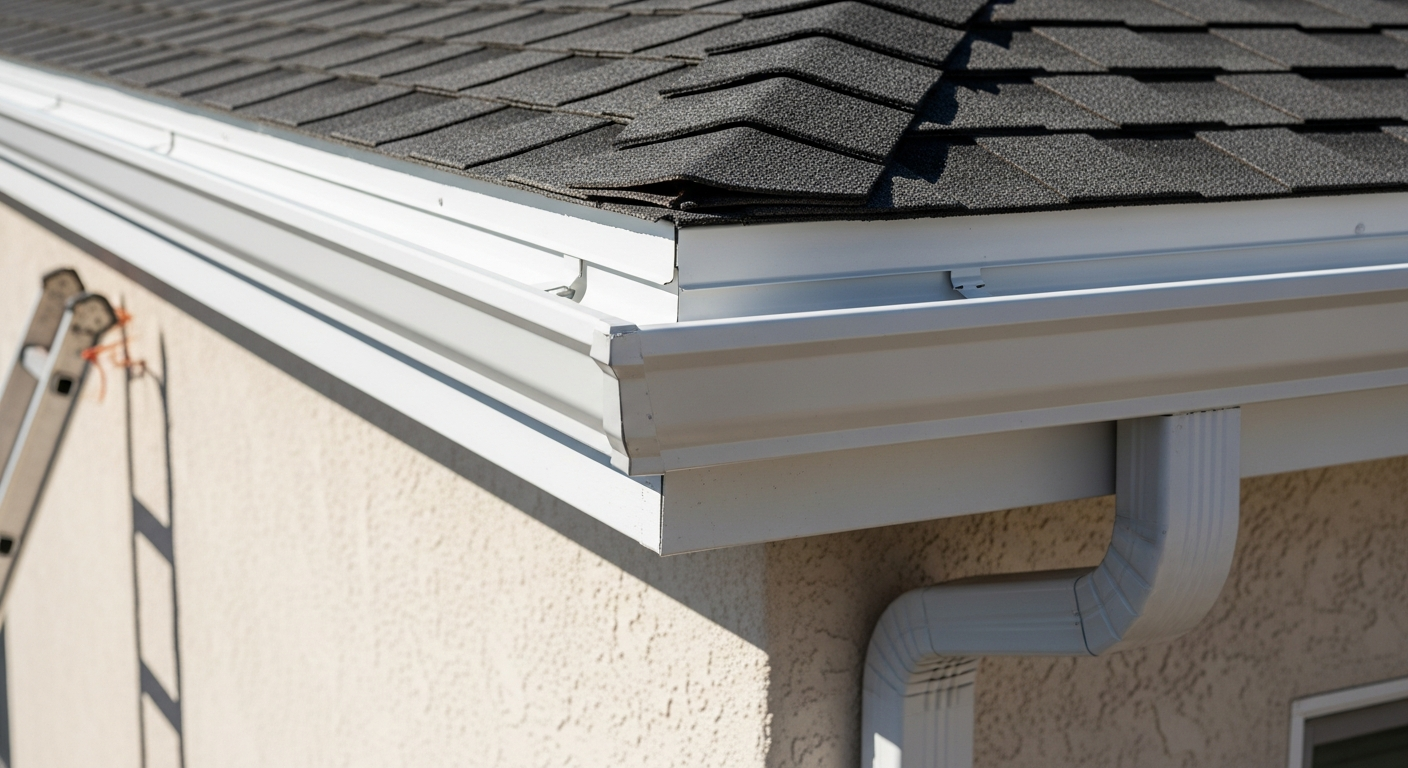
Gutter Installation in Los Angeles
Gutters are the drainage system that keeps water away from your foundation, siding, and landscaping. When they fail, or when they were installed wrong in the first place, the damage shows up in places people do not expect. Foundation cracks, eroded landscaping, stained stucco, and water in the crawlspace all trace back to bad drainage.
We install seamless aluminum and copper gutters across Los Angeles. Every job is custom-formed on-site, hung with hidden hangers, and sloped to drain properly to the downspouts. Free estimates, free fascia inspection, and the old gutter haul-off is included.
Gutter Installation Cost in Los Angeles
Here is what gutters actually cost in LA in 2026, by material and profile. These are real installed prices from jobs we have completed, not “starting at” numbers.
| Gutter Type | Cost Per Linear Foot (Installed) |
|---|---|
| 5” K-style seamless aluminum | $8 - $12 |
| 6” oversize K-style aluminum | $10 - $15 |
| Half-round aluminum | $14 - $22 |
| Copper K-style | $25 - $40 |
| Copper half-round | $30 - $50 |
| Box gutters (custom built) | $20 - $45 |
| Gutter guards (micro-mesh) | $7 - $12 added |
A typical Los Angeles single-family home has 130 to 180 linear feet of gutter once you add up eaves, ends, and any returns. That puts a standard aluminum job at $1,200 to $2,800 all in. Copper on the same house runs $3,800 to $7,500. Gutter guards on top of the install add another $900 to $2,200 depending on length.
Downspouts are usually included in the per-foot price for aluminum, and counted separately for copper. Plan on three to four downspouts on a 1,500 to 2,000 square foot home, more if the roof has multiple planes. Splash blocks or buried drain extensions are extra: $40 to $80 for surface splash blocks, $300 to $900 for a buried run to daylight or a French drain tie-in.
For homes that need fascia repair before the new gutters go up, dry-rotted board replacement runs $8 to $14 per linear foot of fascia. We check this during the free estimate so there are no surprises on install day.
Seamless Gutter Installation Process
Sectional gutters have joints every 10 feet. Every joint is a future leak. Seamless gutters are formed in one continuous piece on-site, eliminating those weak points.
Here is what a seamless install actually involves:
On-site forming. A portable roll-former sits in your driveway and takes a coil of pre-finished aluminum (or copper) and spits out gutter at exactly the length we need. One continuous piece per run, cut to within a quarter inch of the eave length.
Custom cut at corners and ends. Inside and outside corners are hand-cut and riveted with a sealed seam. End caps are riveted and sealed. The only joints in the entire system are at corners and downspout outlets.
Hidden hangers every 24 to 32 inches. We use hidden hangers with a hex screw that drives through the back of the gutter into the fascia. Closer spacing on heavy-rain exposures, wider on protected runs. Old spike-and-ferrule hangers loosen over time as the wood expands and contracts. Hidden hangers do not.
Proper slope. Gutters are pitched at 1/4 inch per 10 feet of run toward the downspout outlet. Set a string line, check it twice, then hang. Without slope, water pools at the low spot and overflows there in every storm.
Outlets and downspouts. Drop outlets are cut, riveted, and sealed into the gutter at the low end of each run. Downspouts are strapped to the wall every 8 to 10 feet, with an elbow at the top to follow the wall and another at the bottom to direct flow away from the foundation.
Kick-out flashing at roof-wall intersections. Where a roof slope meets a wall (common on additions and dormers), kick-out flashing diverts water into the gutter instead of letting it run down behind the wall sheathing. This is where most “siding leaks” actually come from, and it is missed on a lot of installs. We install kick-outs as a standard part of every job.
Splash blocks and extensions 4 to 6 feet from the foundation. Water has to land far enough from the house that it does not soak the soil against the foundation. We install splash blocks or downspout extensions on every run.
The whole install, from setup to final cleanup, is 4 to 6 hours on a typical home. Copper jobs run a bit longer because corners are soldered instead of riveted.
Gutter Installation by LA Area
Different parts of Los Angeles put different stresses on gutters. Here is what we adjust based on where your home sits.
San Fernando Valley
Sherman Oaks, Studio City, Encino, Van Nuys, and the rest of the Valley get sustained heat through summer that bakes the fascia behind old gutters. By the time we pull the old system off, the wood underneath is often dry-rotted or split. We pair a lot of Valley gutter installs with fascia board replacement. Painted aluminum holds up well here because there is no salt exposure, and the heat does not bother the metal itself. Plan on 6-inch K-style for homes with steep or large roof areas because the volume of water that comes off during a Valley downpour can overwhelm a 5-inch gutter fast.
Hillside areas
Hollywood Hills, Mt Washington, Eagle Rock, Silver Lake, and the canyons above Beverly Hills all have one thing in common: trees overhead. Oak, sycamore, eucalyptus, and pine drop debris that clogs gutters within weeks. Gutter guards are not optional on hillside properties, they are part of the install. Downspout routing matters more here too, because dumping water on a hillside lot can erode the slope or send runoff toward a neighbor below. We tie downspouts into existing area drains or run buried PVC to daylight at the property line.
Westside and coastal
Santa Monica, Venice, Mar Vista, Brentwood, and Pacific Palisades sit close enough to the ocean that salt air corrodes painted aluminum faster than inland. We still install aluminum on most Westside jobs because the cost difference is significant, but we use a heavier 0.032 gauge with a baked-on Kynar finish instead of standard 0.027. Copper is worth the upgrade on premium homes and any property where the gutters are visible from the street. Half-round profiles match the architecture on a lot of Spanish Colonial and Mediterranean homes in this area. See our Mar Vista roofing guide for more on what coastal moisture does to building components.
Historic homes
Hancock Park, West Adams, Highland Park, and the older parts of Pasadena have a lot of Craftsman, Tudor, and Spanish Revival homes from the 1920s and 1930s. Half-round gutters match the architecture better than K-style. For homes inside an HPOZ (Historic Preservation Overlay Zone) or with landmark designation, copper is often required, and the existing gutter profile has to be matched closely during replacement. We work with HPOZ guidelines regularly and can pull period-correct profiles for clay-tile and slate-roofed homes.
Flat and low-slope homes
Mid-century moderns, Hollywood and Silver Lake post-and-beam homes, and a lot of the newer modern builds across LA have flat or low-slope roofs. These often use scuppers and box gutters instead of standard hung gutters. Scuppers are openings cut through a parapet wall that drain to an external downspout or a conductor head. Box gutters are built into the roof edge itself, lined with TPO, EPDM, or formed metal. Both are custom work and not something every gutter company handles. We build and reline box gutters as part of flat roof replacements and on standalone gutter projects.
South Bay
Manhattan Beach, Hermosa Beach, El Segundo, Redondo Beach, and the rest of the South Bay coastal cities deal with salt air and marine layer moisture every morning. Marine-grade aluminum (0.032 gauge with Kynar paint) is the minimum here, and copper is common on the higher-end remodels closer to the Strand. Stainless steel hidden hangers and stainless screws are non-negotiable on coastal jobs. We have seen galvanized hangers pull out of fascia in eight years on Hermosa walk streets. Stainless lasts the life of the gutter.
K-Style vs Half-Round vs Box Gutters
The profile you pick matters for capacity, looks, and how easily the system clears debris.
K-style has a flat back that mounts directly to the fascia and a decorative front profile that looks like crown molding from the ground. It is the standard for most LA homes built after 1950. A 5-inch K-style aluminum gutter handles about 1.2 gallons per minute per foot of run, which is enough for most LA roofs. A 6-inch K-style handles about 2.0 gallons per minute per foot, which matters during atmospheric river events and on large roof areas where one downspout has to drain a lot of square footage.
Half-round is a half-cylinder profile. It holds less water per inch of width than K-style (a 6-inch half-round moves about what a 5-inch K-style does) but it self-cleans better because there are no inside corners for debris to catch on. Half-round suits Craftsman, Tudor, Spanish Colonial, and Mediterranean architecture, and in copper it ages into a focal point of the house’s exterior. Slightly more expensive to install because the hangers are different and the corners take more care.
Box gutters are built into the roof edge rather than hung from the fascia. Common on mid-century flat-roof homes and some Spanish Colonials where the gutter is hidden behind a parapet or built into the eave detail. Capacity depends on the width of the box, but they typically handle far more water than a hung gutter. Box gutters need a waterproof liner (TPO, modified bitumen, or soldered metal) and they are not a DIY job. When they fail, leaks travel into the wall cavity, not down the exterior, so problems hide for a long time before they show up inside.
Gutter Guards: Worth It in LA?
It depends on what is near your roof. If you have oaks, sycamores, pines, palms, or eucalyptus within 30 feet of the house, gutter guards pay for themselves in saved cleaning calls and avoided overflow damage. If your lot has no trees and the neighbors do not either, guards are nice but not necessary.
Three main types:
Micro-mesh guards ($7 to $12 per foot installed). Stainless mesh over an aluminum frame that snaps into the gutter and slides under the first course of shingles. The mesh is fine enough to keep out shingle granules, seed pods, and pine needles, but coarse enough to let water flow through. This is what we install on most LA homes. Best balance of debris exclusion and water flow.
Reverse-curve guards ($8 to $14 per foot installed). Solid metal cover with a curved lip; water clings to the lip and follows it into the gutter while debris falls off the edge. Works well for leaves, less well for needles and small debris that can ride the curve into the gutter. Heavy debris loads can overwhelm the system.
Foam inserts ($3 to $6 per foot installed). Foam blocks that sit inside the gutter. Cheap but they degrade in UV within a few years, hold moisture against the gutter (accelerating corrosion), and eventually become a debris trap themselves. We do not recommend foam for permanent installations.
Guards still need maintenance, just less of it. Most properties go from quarterly cleaning to annual cleaning with guards installed. Areas with palms or pines may still need twice-yearly checks because of how much falls.
Downspouts, Drainage, and Foundation Protection
Where the water goes after it leaves the gutter is just as important as the gutter itself. A lot of installers stop at the bottom of the downspout. We do not.
Splash blocks ($40 to $80 each). Concrete or plastic pads at the base of each downspout that direct water 18 to 24 inches away from the foundation. Adequate for most LA properties on flat or gently sloping lots.
Downspout extensions ($60 to $150 each). 4 to 6 foot rigid extensions that get water further from the foundation. Better for homes with landscaping right against the house or with crawlspaces that have flooded in past storms.
Buried drain extensions ($300 to $900 per run). PVC pipe buried 6 to 12 inches deep that carries water from the downspout to daylight at the property line, a dry well, or a tied-in area drain. Right call on lots that slope toward the house, properties with basements, and Westside homes with finished crawlspaces.
French drains ($1,500 to $4,500 installed). Gravel-filled trench with a perforated pipe that collects and disperses water across a wider area. Appropriate for properties with persistent drainage problems, hillside lots where surface runoff erodes the slope, or homes built on heavy clay where surface water has nowhere to go.
LA’s soils are mostly clay (and clay-heavy fill in older neighborhoods). Clay holds water against the foundation and swells when wet. That swelling and shrinking cycle is what cracks slabs, shifts footings, and eventually buckles drywall inside. Proper drainage from the gutter system out to daylight or a drain field is the single cheapest thing you can do to protect a foundation. It is also the thing most gutter installers skip.
If your home has past foundation movement, persistent crawlspace moisture, or visible stucco cracks running diagonally from window corners, the drainage plan matters more than the gutter material. We assess this during the estimate and recommend extensions or drain tie-ins where they are needed.
What Else We Look At Before Installing
Before any gutter goes up, we check the roof and fascia for problems the old gutters were hiding.
Fascia condition. Old gutters trap moisture against the fascia board. By the time we pull them off, the wood is often soft, cracked, or rotted at the corners. We replace bad sections before hanging new gutters, otherwise the new system loosens within a couple of years as the rotted wood gives up.
Drip edge. If your roof does not have proper drip edge flashing at the eaves, water wicks back under the shingles and rots the fascia from above. We install or repair drip edge before gutters when needed, and we tie it into the new gutter so water lands cleanly inside.
Roof condition near the gutter line. The bottom courses of shingles take the most weather. Curled, lifted, or missing shingles at the eaves let water bypass the gutter entirely. A roof inspection before gutter install catches these problems and avoids the awkward conversation where new gutters are installed under a roof that needs roof repair.
Kick-out flashing at wall intersections. Where a roof slope dies into a wall, water has to be diverted into the gutter, not behind the wall. Missing or corroded kick-outs are one of the most common hidden problems we find. We install them as part of the gutter job at no extra charge on standard installs.
For homes that are due for a full reroof, doing the gutters at the same time saves money and avoids damaging new gutters during the tear-off. See our residential roofing page if your roof is past its useful life and you are weighing replacement.
Common Gutter Problems We Repair
Not every call is a new install. A lot of LA homeowners need targeted repairs on systems that are still mostly fine.
- Sagging gutters from failed hangers or rotted fascia. We replace hangers, rehang the run, and fix the fascia where needed. $250 to $700 depending on length.
- Leaking corners and seams on older sectional systems. Reseal or rebuild the corner. $150 to $400 per corner.
- Detached downspouts that have pulled off the wall after a wind event. Re-strap and re-secure with new fasteners. $100 to $250 per downspout.
- Overflow at the front edge caused by improper slope. Re-pitch the run by adjusting hangers. $300 to $900 depending on length.
- Clogs at the outlet that no amount of cleaning fixes. Usually a partially collapsed outlet or a kink in the downspout. Replace the outlet or section of downspout. $200 to $500.
- Damaged sections from fallen branches. Replace the affected section, blending the new piece into the existing color. $300 to $900 depending on length.
If the existing system is more than 25 years old, has rust or corrosion at multiple corners, or sags in three or more spots, a full replacement usually makes more financial sense than chasing repairs. We tell you which path saves money over the next 10 years.
Service Areas
We install gutters across the LA basin. Same-day or next-day free estimates in most areas:
- San Fernando Valley: Sherman Oaks, Studio City, Encino, Van Nuys, North Hollywood, Tarzana, Woodland Hills, Northridge, Chatsworth
- Westside: Santa Monica, Venice, Mar Vista, Brentwood, Pacific Palisades, Culver City, Westwood
- Hollywood and Mid-City: Hollywood Hills, Los Feliz, Silver Lake, Hancock Park, Mid-Wilshire, Koreatown
- Pasadena and San Gabriel Valley: Pasadena, South Pasadena, Altadena, San Marino, Arcadia
- South Bay: Manhattan Beach, Hermosa Beach, Redondo Beach, El Segundo, Torrance, Palos Verdes
- East and Northeast LA: Eagle Rock, Highland Park, Mt Washington, Echo Park
If your address is not on the list, call us. We probably cover it.
Schedule a Free Gutter Estimate
Call (818) 446-6122 for a free gutter installation estimate in Los Angeles. We measure on-site, check fascia condition at no charge, and give you a fixed written price the same day. Most installs are scheduled within one to two weeks of approval.